Why two neighbouring offices can be €300 apart per desk
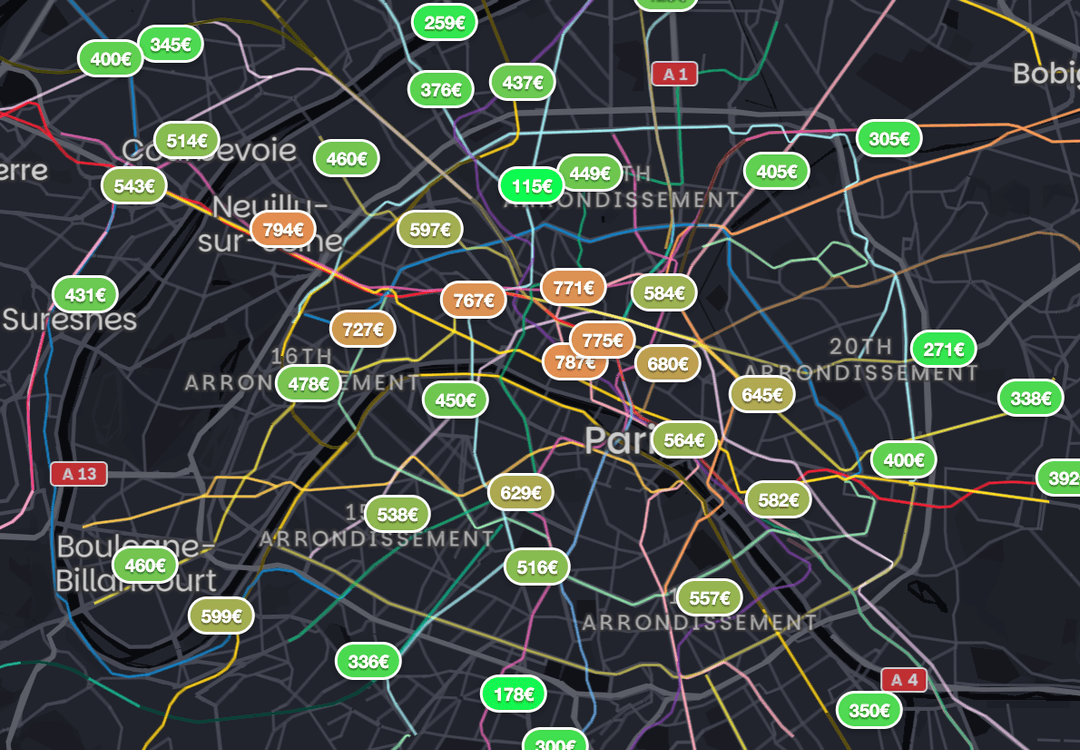

Two spaces three hundred metres apart, in the same arrondissement, can differ by €300 per desk per month. In the 16th, a quarter of spaces go for under €429 a desk, and a quarter for over €871.
This is not a market anomaly. Seven variables explain most of the gap, and none of them shows up in a listing.
👉 Compare available offices and their prices
1. Location: it matters a lot, but not in the way you think
Let's start there, because it is overestimated and underestimated at the same time.
Medians by arrondissement range from €495 (11th) to €690 (8th): a ratio of 1 to 1.4, which looks modest. But the spread in what you can actually get is another story entirely: the Paris market runs from under €200 to over €870 per desk.
- A prime location comes at a price, and sometimes you need to move slightly away from it to make the project fit the budget. Moving from the 8th to the neighbouring 17th saves €139 per desk.
- But an expensive arrondissement does not rule out affordable listings. The 8th has 10 spaces under €450, more than the 11th in absolute terms, because it has far more listings overall. Ruling it out on the strength of its median is a mistake.
2. Density, the quietest variable
There is no standard definition of a "desk". It generally takes up 4 to 10 m² of private space.
The trap lies elsewhere: in business centres and coworking spaces, the private floor area does not include the common areas. The weighted floor area, which adds them back in, is more like 8 to 12 m² per desk.
Two listings quoting "6 m²" and "10 m²" per desk may therefore describe the same reality, one in private area, the other in weighted area. This is the number one cause of misleading comparisons.
Always ask for: the private area, the weighted area, and what each one covers. Then do the division yourself.
3. What the price includes
In principle, a price per desk bundles together rent, service charges, internet, cleaning, furniture and access to common areas. In practice the scope varies: meeting rooms billed by the hour or included, coffee included or not, printing, storage, parking.
Two quotes at the same price can cover very different scopes. Work out the real monthly cost based on how you will actually use the space, not the advertised price.
4. Format, and level of service
| Format | Median in Paris |
|---|---|
| Coworking space | €652 |
| Managed office | €600 |
| Sublet | €407 |
Price per desk per month, excl. VAT, recorded on 21 September 2026. One observation = one space.
A coworking desk costs around €50 more than one in a managed office: you are paying for a desk in a service-intensive venue, rather than an office floor whose common areas are spread across the team.
The same logic explains the gaps within a single format. Some operators offer pared-back set-ups, with fewer common areas and shared services, but efficient spaces at significantly lower prices, even in expensive neighbourhoods. Symphony, in the 8th, comes in at around €400 per desk.
What drives the cost is the common areas and services, at least as much as the address.
For the details of this trade-off, see our coworking vs managed office comparison.
5. Floor, light, view
Within the same building, the gap between a ground floor overlooking a courtyard and a dual-aspect top floor is commonly 20 to 30%. That is also what lies behind a "from" price: it almost always refers to the least sought-after space in the building.
Insist on the price of the space you actually viewed, not the one in the brochure.
6. Commitment period: a lever, not just a cost
Under a service agreement, the commitment ranges from 1 to 36 months. Flexibility comes at a price: an operator that accepts a short notice period takes on a vacancy risk, which it passes on.
But the reverse is an underused lever. Most operators prefer the security of a longer term, and have far more room to manoeuvre when a client commits for 24 months rather than 6. It is not a given, but it is the general rule.
If your outlook is stable, say so early: it is often more effective than haggling over the advertised price. Conversely, a low price tied to a long commitment is no bargain if your headcount could double within a year.
7. The move-in timeline
Operators generally hold a space up to three months in advance. The sooner you move in, the better it suits them, and the more room you have to negotiate.
Some agree to hold it for longer, which is especially true in today's market, but they then require at the very least a signed contract and payment of the security deposit. A space is never reserved on a handshake.
Add to that what no table shows: a newly opened building that needs filling, an office floor that has stood empty for six months. These adjustments are almost never published.
How to compare fairly
Before putting two offers side by side, bring them down to the same denominator:
- Private and weighted area per desk: both, not one or the other.
- Real monthly cost, including your use of meeting rooms and extras.
- First-month cost, including admin and set-up fees.
- Term and notice period, in months, and what you gain by committing for longer.
- Availability date and hold conditions.
- Actual desks, with a chair and a screen, excluding seats in meeting rooms.
An offer at €700 for 9 m² weighted with meeting rooms included can be far better than one at €520 for 6 m² private with meeting rooms charged extra.
Our list of 15 questions to ask on a viewing covers these points one by one.
Comparing without spending three months on it
The seven variables above can be checked, offer by offer. But part of the market is not public, and comparing means having the other offers in hand.
To uncover off-market or lower-priced offers, working with a broker is generally the simplest route.
- It's free for you: the commission is paid by the operator or the landlord.
- They know the market and the operators, the negotiation levers and the real margins.
- They put competing offers head to head to strengthen your hand in the negotiation.
- They gather and sift the offers. No more dozens of email threads, chasing spaces that never reply, or fifteen rounds of viewings. Your search becomes much simpler.
The only exception is certain offers under a commercial lease: our commission is then capped at 10%, compared with the 15 to 30% commonly charged.
Where these figures come from
From our survey of 21 September 2026, covering 477 genuinely available spaces with a published price per desk. A space is a site run by an operator: it can have anything from a few desks to several hundred, and carries the same weight in our medians.
We publish medians and quartiles, never averages: in this market, the average is skewed upwards by a handful of prestige office floors.
Full methodology, thresholds and limitations: our price-per-desk tracker.
See the gaps for yourself
👉 Browse available offices: compare like for like on size, format and commitment.
👉 Let us find your office: we gather the offers, including unpublished ones, and play them off against each other.
Written by Augustin Le Nénaon, co-founder of Desk to Desk. Data collected on 21 September 2026.
Find the ideal office,
without wasting time.
From the first viewing to signing your contract, Desk to Desk supports you every step of the way to ensure a smooth move for your team.