Flexible office space: what it changes for your m² and your budget

Updated 3 November 2026. Prices taken from the Desk to Desk price index for November 2026: € excl. VAT per workstation per month, services included.
Hot desking, which the French call "flex office", means providing fewer workstations than employees, with none assigned: people sit wherever there is space on the days they come in. With hybrid working, most offices are half empty during the week, and hot desking lets you pay only for the workstations you actually use. But the promised savings are often overstated: part of the space freed up has to be reinvested in meeting rooms, quiet areas and lockers. This guide explains how to choose your desk-sharing ratio, calculates the real savings for a team of 30 and shows how to apply it in a flexible office.
The essentials in 30 seconds
- Definition: fewer workstations than employees, and no assigned workstations. It is a way of organising space, not a type of contract.
- The ratio is based on actual attendance: 0.8 workstations per employee for a team in the office three to four days a week, 0.6 to 0.7 for two to three days.
- The real savings: 10 to 25% of the office budget, not 40%, because part of the space freed up is reinvested in meeting rooms and focus areas.
- The limits: peak days, teams that all want to come in on the same day, and roles that need an equipped workstation.
- In a flexible office, hot desking translates directly into fewer workstations billed each month.
What is hot desking?
In a traditional office, every employee has their own workstation: their desk, their screen, their drawer. In a hot-desking office, also known as desk sharing, workstations are no longer assigned. The company provides fewer of them than it has employees, on the basis that not everyone is in at the same time: remote working, business travel, holidays, external meetings. People take a workstation when they arrive, often after booking it in an app, and free it up in the evening.
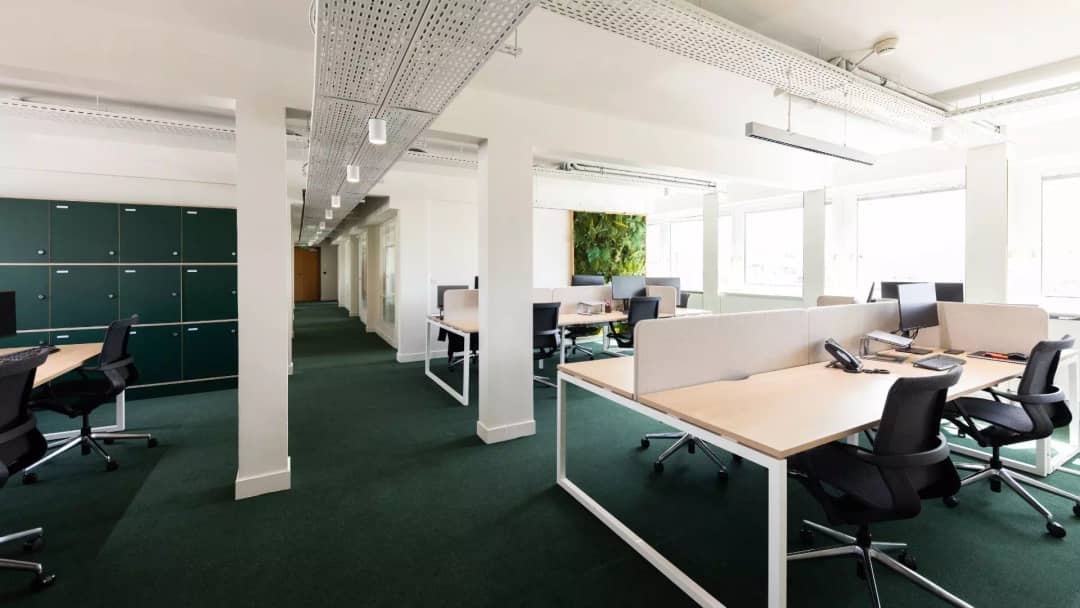
Hot desking almost always goes hand in hand with a different layout, often called "activity-based": fewer rows of workstations in an open-plan area, and more varied spaces depending on what you are doing. Meeting rooms of every size, phone booths, quiet pods for focused work, group workspaces, a kitchen and a breakout area. It is this change of layout that costs money, and that makes the real savings smaller than people think.
Hot desking and flexible offices: two different things
The two ideas are often confused. Hot desking is a way of organising space: fewer workstations than people, and none assigned. It can be used in offices under a commercial lease as well as in a managed office. A flexible office is a way of renting space: space rented per workstation per month, furnished and equipped, with a short commitment, such as a managed office, a private office in a coworking space or a business centre. Our guide to flexible office space explains this second idea.
The two work well together: in a flexible office you pay per workstation, so every workstation removed through hot desking shows up on the invoice straight away, without waiting for a lease to end.
What desk-sharing ratio should you choose?
The ratio is based on actual attendance, not on the stated remote-working policy. Occupancy studies point the same way: on average, an office is occupied around 35% of the time, with peaks of around 56% on the busiest days (Measuremen, 2023). According to JLL, companies moving to hot desking aim for around 0.8 workstations per employee on average. These figures are orders of magnitude: measure your own attendance before deciding, by counting attendance over four weeks or from meeting-room bookings and badge data.
| Average office attendance | Recommended ratio | For 30 employees |
|---|---|---|
| 4 to 5 days a week | 0.9 to 1 workstation per person | 27 to 30 workstations: hot desking adds little |
| 3 to 4 days a week | 0.8 workstations per person | 24 workstations |
| 2 to 3 days a week | 0.6 to 0.7 workstations per person | 18 to 21 workstations |
| 1 to 2 days a week | 0.4 to 0.5 workstations per person | 12 to 15 workstations, with organised team days |
Remember one rule: size for the peak day, not the average. If the whole team comes in on Tuesdays, you calculate the ratio for Tuesday. Keep a 10% margin for exceptional days, internal away days and new hires.
The calculation for a team of 30
Take a team of 30 people in the office three days a week on average, with a peak of 22 people on Tuesdays and Thursdays. The chosen ratio is 0.75: 23 workstations instead of 30.
In a flexible office
At the Paris median price from our Paris office price index, €724 per workstation per month excl. VAT, services included, 30 workstations cost €21,720 per month. With 23 workstations, the bill falls to €16,650, or €5,070 less. But the team will need one more meeting room and booths for calls, the equivalent of around two workstations with most operators. The net saving comes to around €3,600 per month, or 17%, which is €43,000 a year.
Under a commercial lease
At 9 m² per workstation, a comfortable open-plan layout, 30 workstations need around 270 m² and 23 workstations around 210 m². But you need to add back varied workspaces, lockers and meeting rooms: allow 25 to 30 m² more, or around 240 m². Gain: 30 m², 11% of the floor area. At a full cost of €900 per m² per year, including rent, service charges, taxes, operations and fit-out, the saving comes to around €27,000 a year. Our guide to Paris office rents per m² and cost per workstation details this full cost, and our guide to office space per person explains how to calculate the square metres.
The order of magnitude to remember: hot desking saves 10 to 25% of the office budget for a team in the office two to three days a week (more if they come in less), once meeting and focus spaces have been reinvested. Claims of 30 to 40% count only the workstations removed.
What else you need to plan for
- Lockers so that everyone can put their things away in the evening, since the workstation is no longer theirs.
- Quiet areas: phone booths, quiet pods, small rooms for 2 to 4 people. Allow one booth for every 8 to 10 people in the office.
- More meeting rooms, and better equipped for video calls, since some participants are often remote.
- Standardised workstations: the same screen, docking station and adjustable chair everywhere, so that everyone can settle in within two minutes.
- A booking tool for workstations and meeting rooms, with a simple view of who is coming in on which day.
- Clear rules: workstations cleared in the evening, a maximum booking time for meeting rooms, team days.
The limits of hot desking
Hot desking does not suit everyone. Roles that need an equipped workstation (specialised dual screens, design equipment, a trading desk) or a particular need for confidentiality (HR, legal, finance) often keep assigned workstations. Teams that are in the office a lot, four to five days a week, gain almost nothing. And the main risk is the peak day: if the whole company comes in on Tuesday and there are not enough workstations, hot desking turns into a scramble for seats, and employees stay at home. That is why the ratio must be calculated on the peak and reviewed after three months of use.
Hot desking is also a decision to make with your teams: announced as a cost-cutting measure, it is poorly received. Presented as a better-equipped office for the days people come in, with more meeting rooms and more peace and quiet, it goes down much better.
Applying hot desking in a flexible office
Managed offices and private offices in coworking spaces lend themselves well to hot desking, for three reasons. You are billed per workstation: every workstation you give up shows up on the bill straight away. The contract is short: you can adjust the number of workstations after a few months, once actual attendance is known, which a lease does not allow. And the centre's shared areas (meeting rooms, phone booths, kitchen, terrace) supplement the team's workstations without the team paying for them full time.
Two precautions: check that the operator accepts more people than the number of workstations rented (some bill per registered employee, not per workstation), and that enough meeting-room hours are included. For a managed office, the Paris median is €550 per workstation per month, compared with €740 for a private office in a coworking space: see our coworking or managed office comparison. For a team of 20 to 30 people, browse offices for 11 to 20 people and for 21 to 50 people in Paris.
Frequently asked questions
What is hot desking?
What desk-sharing ratio should you use for hot desking?
How much does hot desking save?
What is the difference between hot desking and a flexible office?
Is hot desking compatible with the French Labour Code?
Which teams are not suited to hot desking?
Sources
- JLL, studies on office occupancy and hybrid working, 2026
- Measuremen, office occupancy rates, 2023
- IDET, Buzzy Ratios 2026, cited by La Gazette France on 28 October 2026
- Desk to Desk Paris office price index, November 2026
Let's talk
You are moving to hybrid working and your offices are half empty: our advisers help you set the right number of workstations and find a flexible office that matches your actual attendance. The service is free for you.
Office space for rent in France and Belgium
Managed offices, business centres and coworking spaces, including many off-market listings
Let an English-speaking adviser handle your search: viewings and negotiation, free for tenants.
Find the ideal office,
without wasting time.
From the first viewing to signing your contract, Desk to Desk supports you every step of the way to ensure a smooth move for your team.