Registered business address or real offices: when should you make the move?


Updated 6 November 2026. Rules in force on that date; prices from the Desk to Desk catalogue as at 5 November 2026: € excl. VAT per workstation per month, services included.
A registered business address (domiciliation) gives your company an address, not a place to work. For a company that is just starting out, it is the simplest and cheapest solution: a registered office, mail received and forwarded, sometimes a meeting room by the hour. But the day you hire, meet clients every week or look to raise funds, it is no longer enough. This guide explains what a registered business address allows, the rules to know, the signs that it is time to move to real offices, and the intermediate steps, from a workstation in a coworking space to a private office.
The essentials in 30 seconds
- A registered business address: a registered office address and mail handling, provided by a company approved by the prefecture.
- What it does not do: give you an office to work in every day, or a place to host a team.
- The right time to move to real offices: the isolation of working alone at home, a first employee, regular client meetings, equipment to store, recruitment or a funding round.
- The next step: in Paris, a workstation in the shared area of a coworking space costs €430 excl. VAT per month at the median, from €192; some coworking spaces can also provide your company's registered address.
- Your registered office: you can keep your registered business address and declare your offices as a secondary establishment, or transfer your registered office there.
What a registered business address allows, and what it does not
Using a registered business address means setting your company's registered office – the address that appears on the Kbis (company registration extract), on invoices and on the website – with a company that specialises in this: the registered address provider (société de domiciliation, or domiciliataire). It receives your mail, forwards or scans it, and must make a room available to you for your directors' meetings and for keeping your documents. Depending on the package, it may also rent out offices by the hour, or provide telephone answering or a reception service.
A registered business address does not give you an office. You work elsewhere: at home, at your clients' premises, in cafés or community workspaces. For a company with no employees whose director is often on the move, that is enough. For a team that needs to get together, work side by side and receive visitors, it no longer is.
The rules to know
Registered business addresses are governed by the French Commercial Code (Code de commerce). Four rules matter.
- An approved provider. A registered address provider must be approved by the prefect (in Paris, by the Prefect of Police) before registering (Articles L123-11-3 and R123-166-1 of the Commercial Code). Approval is valid for six years (Article R123-166-3). The provider must have a room that guarantees confidentiality, in premises it owns or rents under a commercial lease, and cannot operate from a main residence or from mixed-use residential premises (Article L123-11-2). Operating without approval is punishable by six months' imprisonment and a €7,500 fine (Article L123-11-8).
- A written agreement of at least three months. The registered address agreement (contrat de domiciliation) is concluded for a minimum of three months, renews automatically, and states the approval references (Article R123-168). When it ends, the provider informs the commercial court registry (greffe).
- Obligations for you too. The company using the address undertakes to genuinely and exclusively use the premises as its registered office, to report any change (business activity, directors, legal form) and to authorise the provider to receive its mail and official notifications (Article R123-168).
- The director's home, without going through a provider. The prohibition above applies to registered address providers, not to you: your company can set up its registered office at the home of its legal representative, unless a law or a clause provides otherwise, for example in the lease or the co-ownership rules (règlement de copropriété). If such a clause exists, the registered office can stay there for no more than five years from the company's formation, and the landlord or the building's managing agent (syndic) must be informed in writing before registration (Article L123-11-1). Three months before that period ends, the registry asks for the new address; with no reply, it strikes the company off the register automatically (Article R123-171).
These rules apply to the registered office. They say nothing about where you work: nothing prevents you from having your registered address in a business centre and renting offices elsewhere, provided you declare those offices if they become a permanent place of business (see below).
Seven signs it's time to move to real offices
- You work alone, and it starts to weigh on you. Working from home day after day, you become isolated and lose motivation and efficiency, between household distractions and the lack of interaction. An office, or simply a workstation in a coworking space, separates your working life from your private life and surrounds you with people who are also moving forward: you feel more stimulated and more focused. It is often the first trigger, even before the first hire.
- You are hiring. An employee needs a workstation, and you must guarantee working conditions that comply with the French Labour Code (Code du travail). Full-time remote working does not suit every job or every profile.
- You meet clients every week. Renting a room by the hour works as a one-off; beyond that, an office of your own often costs less and saves you looking for a venue for every meeting.
- You have equipment or stock. A registered business address does not let you store anything.
- You are recruiting. Candidates look at where they will be working; a registered address with no office can hold back recruitment.
- You are raising funds or responding to tenders. Investors and buyers check the address; real offices reassure them that the company is solid.
- Your spending on cafés, meeting rooms and community workspaces exceeds the price of a workstation. Do the maths over three months: if you spend more than €200 to €400 per person per month, a workstation in a coworking space costs the same, with a proper working environment.
The steps, from a registered business address to a private office
Between a registered business address and an office lease, there are several steps, with no fit-out works and no long commitment. At each step, the price includes furniture, internet, cleaning and, in most cases, access to meeting rooms.
| Step | What you get | Price in Paris | Commitment |
|---|---|---|---|
| Registered business address | an address, mail handling, a room by the hour depending on the package | €10 to €99 excl. VATaccording to Legalstart, October 2025 | 3 months minimum |
| Workstation in a shared space | a workstation in an open-plan area, meeting rooms | €430 medianfrom €192 | often monthly |
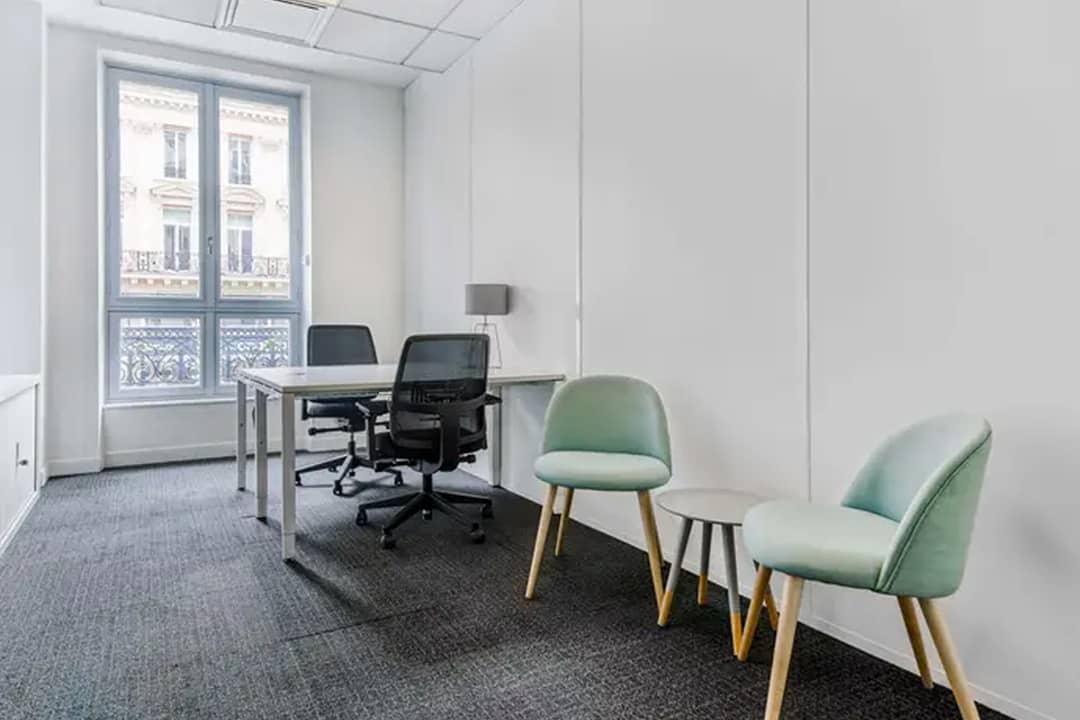
| Private office for 1 or 2 people | an enclosed office of your own, in a coworking space or a business centre | €833 per workstation medianfrom €225 | often monthly, sometimes 3 to 12 months |
| Private office for a team | an enclosed office for 3 to 15 workstations | €730 per workstation medianfrom €188 | usually 3 to 12 months |
| Managed office | a private office floor fitted out and run by an operator | €590 per workstation medianfrom €270 | usually 1 to 3 years |
Prices excl. VAT, per month, services included, Desk to Desk catalogue in Paris as at 5 November 2026, except for the registered business address. The price per workstation falls as the team grows: an office for one person costs more per workstation than an office for ten. Our comparison coworking or managed office: how prices compare details the differences, and our guide to offices for a small team in Paris helps you choose for two to ten people.
As long as they are on their own, many startup founders begin in a shared space: a workstation in a coworking space, or a few workstations sublet in another company's offices, with the consent of its landlord (see our comparison commercial lease or sublet). There they find structure and a stimulating atmosphere, with no long commitment, before taking private offices as the team grows.
For a company that is starting out, a workstation in a coworking space is often the best first step: it costs barely more than a community workspace membership, it gives you a real place to work and meet, and some approved coworking spaces can also provide your company's registered address, combining address and office in a single contract. Our guide to coworking in Paris and our guide to startup offices in Paris set out the options.
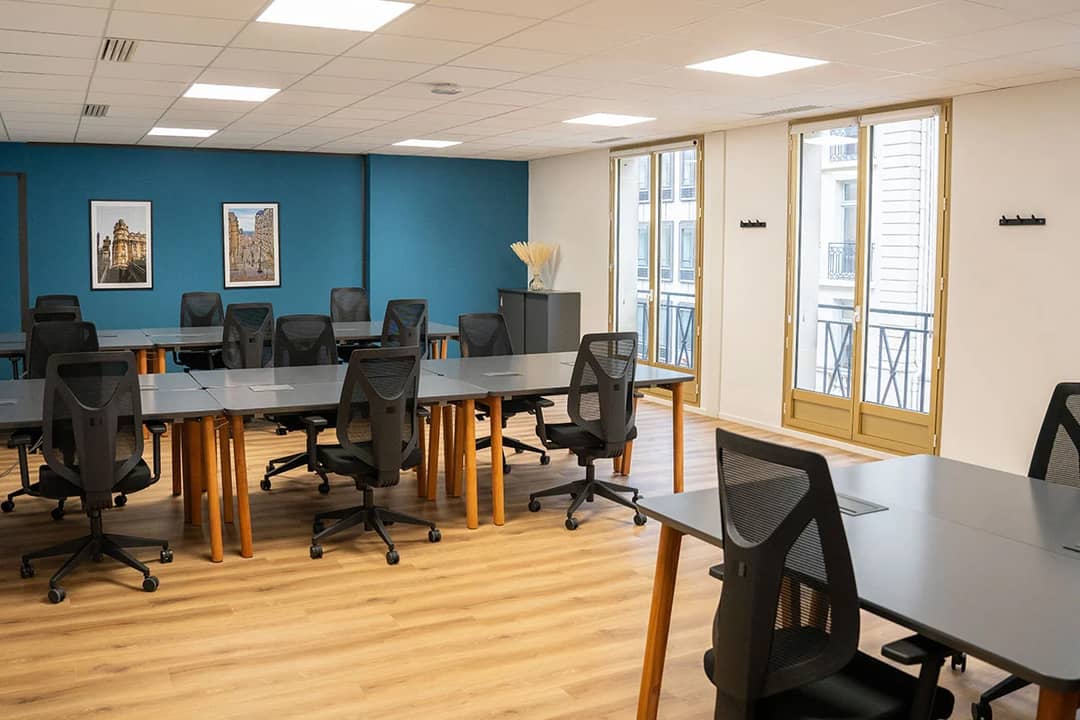
Rue de Monceau (8th) · Avenue de l'Opéra (1st) · Rue de la Victoire (9th) · Rue Bichat (10th) · Avenue Ledru-Rollin (12th) · Rue Albert-Bayet (13th): offices for one or two people at under €400 per workstation.
Keep your registered address or transfer your registered office?
When you take on offices, you have two options.
- Keep the registered address as your registered office and declare your offices. Your new offices become a secondary establishment if they fall within the jurisdiction of a different registry, or an additional establishment (établissement complémentaire) if they fall within the same one. The declaration is made via the one-stop shop for business formalities (guichet unique), within the month before or after opening. Failing to declare an establishment is penalised, notably under the rules on undeclared work (travail dissimulé). The registered office stays at the registered address, which must remain your genuine registered office (siège effectif).
- Transfer the registered office to your offices. The transfer is decided by the shareholders: under the conditions set out in the articles of association in an SAS, and by shareholders holding more than half of the shares in an SARL. You must amend the articles of association, publish a legal notice and declare the transfer within one month, with proof of occupancy of the new premises: the lease or the office agreement. You then terminate the registered address agreement in line with the notice period it provides for.
The choice depends on how long you are committing to the offices, the cost of the formalities and the image you want to project: get advice from your accountant or a corporate lawyer.
What about a commercial lease?
For a small team, a standard commercial lease is rarely the right next step: in practice, a commitment of at least three years for the tenant, a security deposit, and fit-out works and furniture to finance. Either a short-term lease (bail dérogatoire) or a professional lease (bail professionnel) offers more flexibility. Our guide office lease: which contract to choose compares the options, and our article on business centres in Paris presents the spaces that combine a registered business address, offices and services.
This is not legal advice. This guide sets out the general rules in force on 6 November 2026. Before transferring your registered office, terminating your registered address agreement or declaring an establishment, have your situation checked by your accountant or a corporate lawyer.
Frequently asked questions
Can you register your company's address in a coworking space?
How much does a registered business address cost?
Do you have to transfer your registered office when you take on offices?
Registered business address or commercial lease: what is the difference?
Sources
- Code de commerce (French Commercial Code), Article L123-11-1 (registered office at the legal representative's home), Légifrance
- Code de commerce (French Commercial Code), Articles L123-11-2 et seq. (registered business addresses, approval), Légifrance
- Code de commerce (French Commercial Code), Article L123-11-3, version of 27 June 2026, Légifrance
- Code de commerce (French Commercial Code), Articles R123-166-1 to R123-171 (approval, registered address agreement), Légifrance
- Entreprendre.service-public.fr, Transfert du siège social d'une société (transferring a company's registered office; checked on 5 September 2025)
- Entreprendre.service-public.fr, Ouverture d'un établissement secondaire ou complémentaire (opening a secondary or additional establishment; checked on 18 February 2026)
- Legalstart, Tarif d'une domiciliation commerciale (price of a registered business address; updated 22 October 2025)
- Desk to Desk catalogue, Paris, 5 November 2026
Let's talk
First employee, first clients, first funding round: our advisers help you find the right step, from a workstation in a coworking space to a private office, and negotiate on your behalf. The service costs you nothing.
Office space for rent in Paris
median €724 per desk per month excl. VAT, from €150
Let an English-speaking adviser handle your search: viewings and negotiation, free for tenants.



Find the ideal office,
without wasting time.
From the first viewing to signing your contract, Desk to Desk supports you every step of the way to ensure a smooth move for your team.