A startup’s first office in Paris: when, which option, what budget
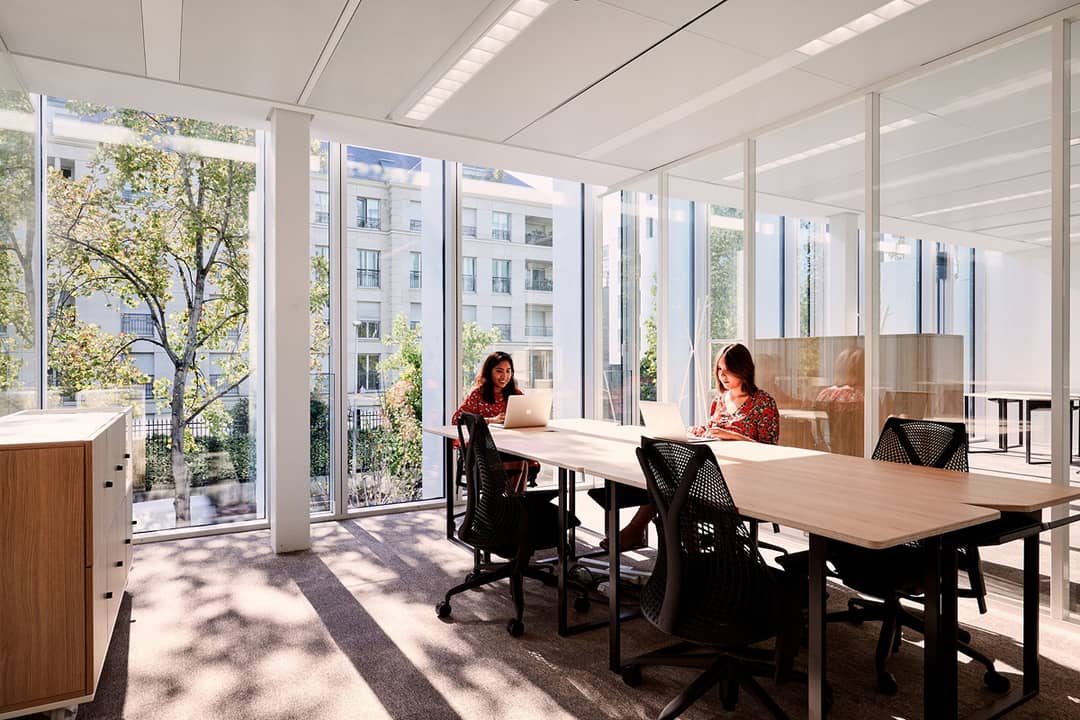

Updated 3 November 2026. Prices taken from the Desk to Desk price index for November 2026: € excl. VAT per workstation per month, services included.
A Paris startup changes offices two or three times before reaching 50 people: a coworking desk for the founders, a private office as the team grows, then a managed office or a first lease once the organisation settles. At every stage, the classic mistake is the same: committing for too long to space sized for the hiring plan rather than the actual team. This guide describes the three ages of a startup, the signs that it is time to move on, the option to aim for after a funding round and the budgets to plan for, based on our Paris office price index.
The essentials in 30 seconds
- 2 to 5 people: coworking, in an open-plan area or a small enclosed office, with no commitment. Budget: around €2,800 per month for four people in a private office.
- 6 to 20 people: a private office in a coworking space or a small managed office, with a 6 to 12-month commitment. Budget: around €6,600 per month for ten people.
- 20 to 50 people: a managed office in your own branding, 12 to 24 months, or a first lease if the team is stable. Budget: around €14,000 for twenty people, €24,500 for forty.
- After a funding round, plan space for your next 12 months, not your next 36, and keep an expansion option rather than taking an office floor that is too big.
- The search takes time, often every year. An office space broker like Desk to Desk brings the listings together, groups the viewings and negotiates, at no cost to you.
- All prices: € excl. VAT per month, services included, medians from our November 2026 price index.
The three ages of a startup, three office options
2 to 5 people: coworking
At the start, the priority is to tie up no capital. A coworking space gives you an address, a meeting room to receive visitors, internet and coffee, with no fit-out works or significant security deposit, and you can leave with one month's notice. There are two options: workstations in an open-plan area, the cheapest, or a small enclosed office of 2 to 5 workstations, quieter for calls and confidentiality. Incubators and accelerators sometimes offer workstations, free or nearly free, for the length of the programme: take them, but plan your exit.
At this stage, the question is less about price than flexibility: you might double in six months, or have to scale back. See the offices available for 1 to 2 people and for 3 to 5 people in Paris.
6 to 20 people: a private office or a small managed office
Beyond six people, a shared open-plan area becomes difficult: noise, calls, the confidentiality of hiring and financial figures. The team needs a space of its own, with its own meeting room. Two options fit. A private office in a coworking space keeps the buzz of the venue, the events and the shared areas, with commitments of 3 to 12 months. A managed office, a whole office floor furnished and run by an operator, gives more privacy and room for an often lower price per workstation, in exchange for a slightly longer commitment. Our guide to the private office in a coworking space covers the first option, and our guide to the managed office the second.
20 to 50 people: a managed office in your own branding or a first lease
From around twenty people, the startup becomes a company with a culture, rituals, and clients and candidates to receive. It often needs its own spaces: several meeting rooms, a kitchen where the team gets together, quiet pods to focus, sometimes a studio or a product area. The managed office remains the most common option: the operator fits out the floor, sometimes in your colours, and takes care of everything else. A first commercial lease is worth considering when headcount is stable, cash flow can fund the fit-out and the horizon is longer than three years. Our comparison commercial lease or sublet and our guide to setting up 20 people in Paris will help you decide.
Six signs it is time to leave your coworking space
- The meeting rooms are always taken when you need them, and your interviews or client meetings happen in a café.
- Calls happen in the corridors: the sales or support team no longer has anywhere to talk without disturbing others or being overheard.
- You turn down hires for lack of space, or split the team across two offices that never see each other.
- Your bill is spiralling: extra workstations, meeting room hours charged, printing, lockers. Beyond 10 to 12 people, compare with a managed office; the difference often exceeds 20%.
- You handle sensitive data (health, finance, key accounts) and the shared environment raises confidentiality concerns.
- The team wants a place of its own: culture is hard to build in a space where you cannot put anything on the walls or arrange anything.
Two or three of these signs are enough to start a search. Allow four to eight weeks between the first viewing and moving in for flexible office space, and three to six months for a lease with fit-out works.
A search that takes time, often every year
People almost always underestimate the time an office search takes. You have to track down listings across a dozen websites and as many operators, call each one to check availability and the real price, fit viewings into already full diaries, compare contracts that look nothing alike, then negotiate. For a startup, this is not a one-off exercise: with 6 to 12-month commitments and a team that doubles, many change offices every year, or nearly. That time comes out of the founders' day, or the office manager's, for whom it is just one task among many: hiring, onboarding, suppliers, events.
That is why we strongly recommend using a specialist office space broker like Desk to Desk. In practice:
- A search at no cost to you: you pay nothing, whether for the search, the viewings or the negotiation.
- The market's listings in one place: coworking spaces, business centres, managed offices, sublets and leases, including listings that are rarely or never advertised, presented in the same format so you can compare them.
- A single point of contact who knows your team and your constraints, so you do not have to explain them again to every operator.
- Viewings organised and grouped together: several spaces in the same half-day, in a logical order, rather than one viewing a week for two months.
- Negotiation handled for you, with knowledge of the prices actually signed, neighbourhood by neighbourhood.
The benefit is simple: your team spends its time on what it does best, your product and your clients, rather than on a time-consuming office search. And when the next move comes round, your adviser already knows your history.
After a funding round: which option, what size?
A funding round changes the timeline: the plan often involves doubling the team within 12 to 18 months. The temptation is to take offices for the future team straight away. It is the main mistake we see, for three reasons. Hiring almost always takes longer than planned; a half-empty office floor is expensive and gives candidates a poor impression; and a firm lease ties up the cash the round was meant to put into growth.
The rule we recommend: size for your headcount over the next 12 months, with a 15 to 20% margin, and negotiate an expansion option (a neighbouring office, an extra floor with the same operator) rather than paying in advance for empty workstations. A managed office over 12 to 24 months works well for this: the fit-out is included and you can often change size within the same network. To choose the contract, see our guide office lease in France: which contract to choose.
What budget to plan for by team size
Here are the median monthly budgets recorded by our price index in November 2026 for a private or managed office in Paris, services included (rent, service charges, cleaning, internet, furniture, access to meeting rooms depending on the space).
| Team size | Median budget per month | Most common option |
|---|---|---|
| 2 peopleestimate | around €1,450twice the median per workstation, often less in an open-plan area | Coworking, dedicated desks or a small office |
| 4 people | €2,760 | Private office in a coworking space |
| 10 peoplelistings of 8 to 12 workstations | €6,560half of listings between €5,440 and €8,640 | Private office or small managed office |
| 20 peoplelistings of 16 to 25 workstations | €14,000half of listings between €11,750 and €17,560 | Managed office |
| 40 people | €24,500 | Managed office or first lease |
The price per workstation falls as the team grows: from €690 for four people to around €610 for forty. It varies above all by neighbourhood: a median of €495 per workstation in the 18th arrondissement, €580 in the 13th, €872 in the 2nd. The type of space counts too, with the managed office coming out at a median 26% cheaper than a private office in a coworking space (€550 versus €740). To see listings within your budget, browse offices under €2,500 per month or under €5,000 per month, or by size for 6 to 10 people and for 11 to 20 people.
Which neighbourhood for your startup?
The choice depends first on the team: where do your employees live, and above all the people you want to hire? An office less than 40 minutes away for most of them is better than a prestigious address. Next come the clients and investors you need to receive, then the budget. Sentier and the 2nd remain the historic heart of Paris tech, expensive but in high demand. The 9th, 10th and 11th offer a good compromise, with Gare du Nord and Gare de l'Est for teams that travel. The 13th, around Station F, and the 18th are much more affordable. Our guide where to set up your offices in Paris compares the neighbourhoods in detail.
Pitfalls to avoid
- Committing too long, too early. A nine-year lease with a three-year break, or a 36-month managed office, for a team of 12 aiming for 40: if the plan changes, getting out is expensive.
- Overestimating growth. Size on signed and likely hires, not on the plan presented to investors.
- Forgetting about hiring. Your offices are part of what you offer candidates: light, transport, neighbourhood, rooms to get some quiet.
- Comparing prices that are not comparable. A workstation in an open-plan area and one in an enclosed office, a price with or without meeting rooms, with or without service charges: ask for the all-inclusive monthly price.
- Overlooking the notice period. Check how long the notice period is and the date by which it must be given: tacit renewal can sometimes commit you for a further term.
- Signing without negotiating. Operators often grant a free month, a sliding-scale price or an expansion option: see how to negotiate flexible office space.
Frequently asked questions
How much does an office cost for a startup in Paris?
When should a startup leave its coworking space?
Should you sign a commercial lease after a funding round?
How much space does a startup need?
Private office in a coworking space or managed office: which to choose?
How long does it take to find offices?
Should you use a broker to find your offices?
Sources
Let's talk
You have just raised funds, you are leaving an incubator or your coworking space is overflowing: our advisers shortlist offices that fit your team and your budget, group the viewings into a few half-days and negotiate for you. The service is free for you, and we remain your point of contact for your next move.
Office space for rent in Paris
median €724 per desk per month excl. VAT, from €150
Let an English-speaking adviser handle your search: viewings and negotiation, free for tenants.
Find the ideal office,
without wasting time.
From the first viewing to signing your contract, Desk to Desk supports you every step of the way to ensure a smooth move for your team.